

In the second installment of Gareth Leaman’s commentary on the state of the nation, he explains the appeal of Reform.
Reform’s rise is a symptom of liberalism’s failure
The nature of Welsh devolution described in my previous blog, combined with the wider backlash against liberal capitalism, leaves Welsh Labour fatally vulnerable to a political force like Reform. As noted in my Caerphilly report,
‘Welsh Labour is the political embodiment of [the administrative class]: the ultimate middle managers, with the Senedd the ultimate institution of passive mediation between capital, state and public. With minimal autonomous economic powers (which Welsh Labour has historically resisted expanding), devolution can achieve little more than treating the symptoms of Westminster austerity to varying degrees of effectiveness.
At best it attempts to inoculate Wales against Tory inhumanity. At worst, it internalises and embeds the logic of neoliberalism that has plagued every level of UK governance for decades. It should shock nobody that support for the party – and confidence in the institution it has run for 25 years – is collapsing in line with this worldwide upsurge in discontent.’
(Most of that article – and everything which explains Reform UK’s influence on Welsh politics – is based on this thesis. So, again, for a deeper understanding: go and read it if you haven’t already.)
Reform’s popularity must be understood as an ‘anti-establishment’ phenomenon
Organised opposition to Reform will achieve little until it recognises Reform as an ‘anti-establishment’ force.
Clearly, capital is failing. Or, more accurately, capitalism is failing people: capital itself remains intact. In real terms, the management of the economy is increasingly unable to sustain adequate living conditions for the majority, while remaining capable of reproducing the conditions of wealth accumulation for an increasingly selective elite minority. Our liberal economic custodians cannot account for this, and have spent decades insisting that everything is structurally robust even as the social order disintegrates around them.
Into this wreckage step the likes of Reform and the politics they represent: circumventing and exploiting crises of capital – an ‘anti-capitalism’, in a perverse sense – in order to become its last remaining beneficiaries. In this, they fully acknowledge the failures of capitalism, which the broken polity recognises and identifies with, and leave its defence to ‘the liberal establishment’.
Again, from the Caerphilly article:
‘As tolerance for the political establishment breaks, we’ve seen a concurrent rise in the ‘anti-elite’: not anti-capitalists as such, but those lauded as having mastered capital for their own ends, in opposition to the public-servant ‘capitalists’ directly overseeing the managed decline of communities.’
Reform’s appeal, therefore, lies in acknowledging systemic failure while purporting to be capable of bargaining with capital to extract the most value for its voter base, in a form of reactionary anti-establishmentarianism. As I’ve noted in a previous essay:
‘Through their success, such figures set the coordinates for ruthlessly negotiating the landscape of capitalism, demonstrating ways of ‘bargaining’ with capital in order to thrive (or at least survive) among its indentured hardships. Whether presented as an against-the-odds everyman or victorious strongman (or elements of both), each notable new-right ‘capitalist’ possesses their own variation on the same basic mission statement that tacitly posits capital itself as the ‘enemy’. It says, “the demands of capital can rip you to shreds, but follow after me and I can help you make the most of it”. Where they acquire political influence, provisions can be made for further, more severe shortcuts to help get ahead in the thrive-or-die society, largely by eliminating or repressing large swathes of ‘the competition’ from the market, or stripping away supposed institutional impediments to success: immigrants, women, traitorous leftists, the social state, etc.’
It should, of course, go without saying that the promises of salvation here are mostly illusory. In many ways, Reform’s politics is simply a crude intensification of the culture of Thatcherism already sadly dominant in modern British culture: the false freedom of the individual, predicated upon the suppression of others’ individual freedom, and at the expense of true liberation through collectivism.
Postindustrial Wales is the perfect place for Reform’s politics to take hold
Wales has endured a decades-long socioeconomic decline, in which deindustrialisation has given way to all the malign consequences of marketisation. Little economic life remains beyond institutional residue and a weak industrial base: public bodies, a service sector and the wild west of self-employment – the ghost of a social state mopping up the crises that insecure or low-quality work engenders.
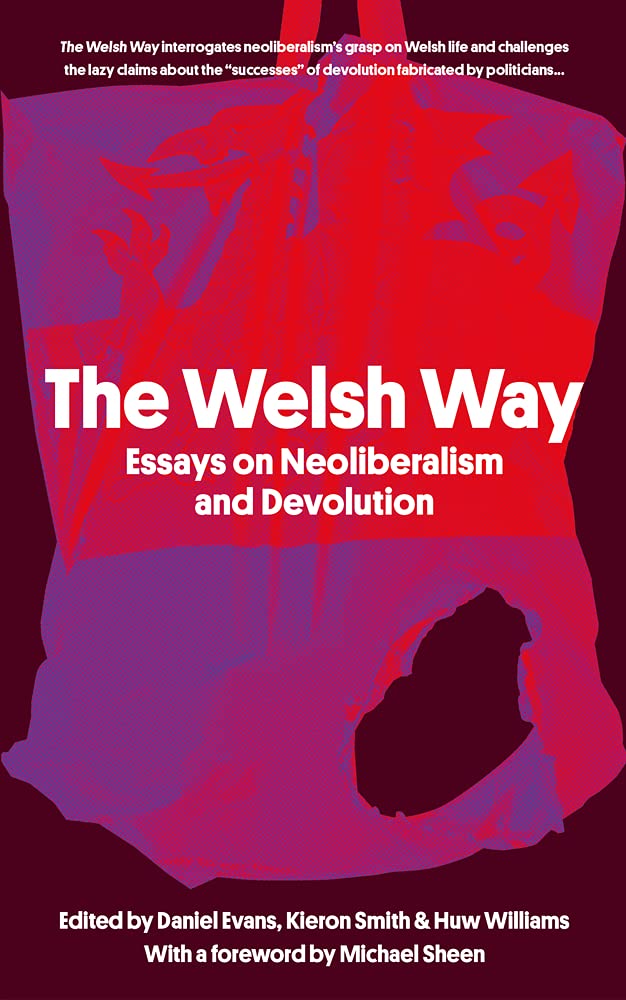
Capitalism no longer expands through new spatial frontiers, but through dismantling existing, stagnant territories of production and reappropriating the ruins. Wales’ lack of economic sovereignty leaves it particularly vulnerable to this recomposition being imposed on it. We’ve seen this plenty already: manufacturing heartlands transformed into sprawls of warehouses and call centres, its inhabitants offered up as cheap and exploited labour, its land appropriated for private housing stock.
Such conditions are ideal for Reform’s disaster nationalism to take hold. Frustrations created by the current political settlement, with its inability to produce public prosperity, are redirected towards a politics of resentment that manufactures consent for yet further subsumption into the market – and all the misery that entails.
We’ll consider these long term prospects in the final part.