
When the leaders of Plaid Cymru, the SNP and Sinn Féin met in Cardiff last week, they claimed that “Westminster’s time is coming to an end” and asserted the right of their nations “to determine its own future, through democratic means”. As expected, Burnham has already dismissed a Scottish referendum as “off limits” and argued that Irish reunification was “off the table”. While these comments have been rightly criticised for undermining a fundamental principle of the Good Friday Agreement, more generally it reveals the fact that Westminster sees self-determination not as an inherent right but as a gift that it can grant or withhold from London.

Burnham has unsurprisingly had little to say about Welsh independence, other than to suggest “a different arrangement for Wales” was not possible. This is also reflected in Plaid’s more hesitant approach on the matter and its fear of alienating sceptics. Welsh independence is often dismissed on the basis that we are too small, too poor, and we have a fiscal deficit. We are seen as a nation dependent on the current structures provided by the United Kingdom.
As a counter-argument, it is common in Welsh independence circles to look for evidence from other small nations. For us, that inspiration often comes from across the Irish sea.
Irish independence was of course born under very different circumstances, through the sacrifice and brutality of revolution, civil war, and the painful reality of partition. However, the Irish Home Rule and later independence movements were frequently undermined on the familiar basis that it was economically unviable. As such, it is no surprise that Ireland has historically been, and continues to be, a key reference point for Welsh nationalists. The First Minister Rhun ap Iorwerth once claimed: “I see the possibilities [of independence] evidenced through what we are seeing in Ireland…What I see is a nation that has been able to map out its own destiny, to make its own mistakes and try to learn from them.”
Having recently moved across the Irish sea, I can understand this sentiment. Independence is often framed through these grand and abstract ideals of self-determination, but its beauty is more evident in the mundane things that are part of everyday life. It is in the GAA (Gaelic sports) clubs at the heart of local communities, the late-night rebel songs in pubs and weddings, and the Palestinian flags flying everywhere. These are all part of Ireland’s past anti-colonial struggles and its fight for independence.
I have even joined an international Gaelic sports team, playing hurling and Gaelic football with players from around the world, and my children do “Irish dancing” at trad sessions in pubs (and sometimes even to K-pop). The contrast with home can be stark. In Wales we have Queen streets, Kingsways, the Prince of Wales bridge, and portraits of the royal family in important buildings. In Ireland the streets and landmarks are named after rebels, pubs have photos of them, and there are plaques and statues across the country—from my wife’s grandmother’s village in rural west Limerick to the park outside my son’s school in Dublin.
Our local park is named after one of the leaders of the 1916 Easter Rising who fought against the British Empire, Éamonn Ceannt, rather than Lord Bute, who exploited Welsh working class miners and masses of Irish Famine refugees to fuel that same Empire. Ireland’s rich revolutionary history can never be taken away, it is a resource that it can always drawn upon. And, while the British state remains present in Ireland, living in the Republic I often feel like I am living in the shadows of these revolutionaries, in an Irish utopia that I could only dream of in Wales.
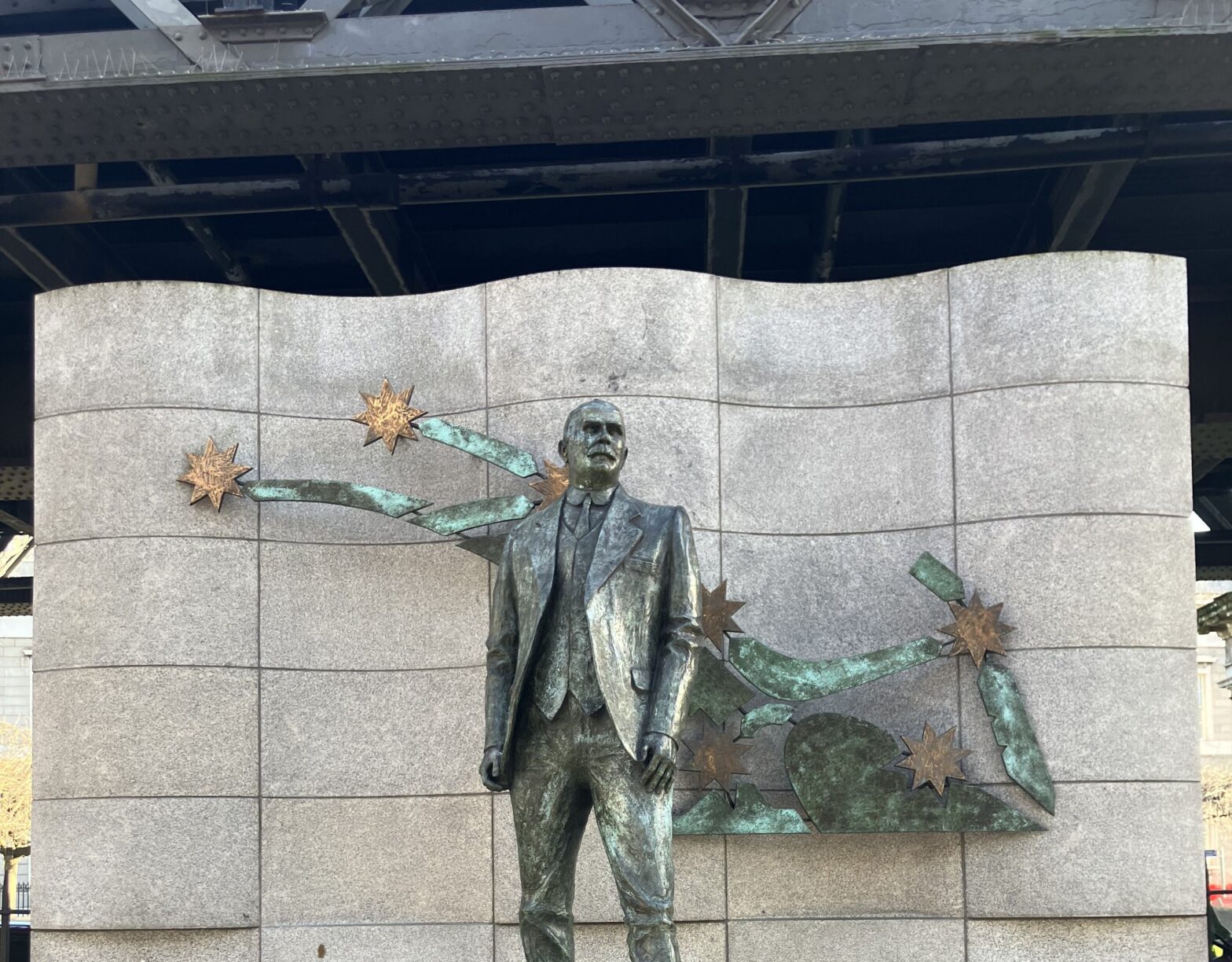
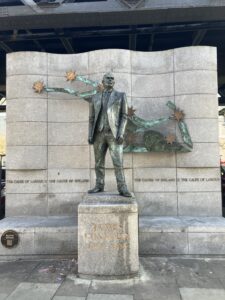
Cultural revival and political emancipation were a key part of the Irish independence movement, but many Irish socialists at the time warned that this was not enough. A stone’s throw from the statue of socialist James Connolly in Dublin—one of the leaders of the 1916 Easter Rising—is the International Financial Services Centre (IFSC). Built to attract foreign capital and companies to the country, the IFSC represents an economic model that is a kick in the teeth to Connolly’s vision of a socialist republic.
Snapping out of my Irish republican fantasy is not hard because Ireland has become a who’s who of American tech and pharma giants: Google, Meta, Apple, Microsoft, Intel, Eli Lilly, and Pfizer, to name just a few. If we once looked towards Ireland’s republican spirit for inspiration, it is now the glitz and glamour of multinational Ireland that we are looking towards.
Writing ahead of the election, Guardian writer Simon Jenkins suggested that Ireland’s economic model could act as a blueprint for our future in Wales. Rhun ap Iorwerth and his party’s predecessor Adam Price have also praised its economic growth, while Yes Cymru have pointed towards Ireland’s economic growth as a response to concerns about the “affordability” and economic limits of independent small nations like Wales. Since we are keen to frame the economic possibilities of independence through Ireland’s success, let’s take a closer look at it.
IRELAND AS A TAX HAVEN
Ireland has recently experienced a remarkable growth in its GDP, doubling from around $300 billion in 2015 to $600 billion today. It now has the 5th highest GDP per capita in the OECD, with the IMF projecting that it will soon be the richest country in Europe. This has been celebrated by many, and understandably so given Ireland’s history of colonial exploitation, post-independence poverty, and the devastation of the 2008 crash. What was the cause of its changing fortune and why is it a problem?
Economist Paul Krugman famously described this GDP boom as “Leprechaun Economics”: it was a distorted figure that did not reflect actual economic activity. Instead, it was explained by Ireland’s changing role in facilitating global tax avoidance for multinational companies (MNCs).
Ireland adopted an economic development strategy to attract Foreign Direct Investment (FDI) as early as the 1950s, incentivised through “competitive” corporation tax rates. Over the decades, many of the world’s largest and wealthiest MNCs set-up subsidiary companies, offices, and factories across the country. From the 90s, the “Double Irish” loophole allowed companies incorporated in Ireland to be effectively stateless for tax purposes. Ireland became a funnel for US-based companies to shift profits through its Irish subsidiary and into a tax haven, usually in the Caribbean. This created “one of the world’s most successful tax avoidance schemes, sheltering up to a trillion dollars” for multinationals. Following the unwanted attention brought about by the infamous Apple case, this loophole was closed in 2015 and gradually phased out by 2020.
With these changes, many multinationals became tax resident in Ireland and relocated their intellectual properties (IP)—patents, trademarks, copyrights—to their Irish subsidiaries. As political-economist Aidan Regan explains, this meant that global sales of software, digital services, or patented medicines were now being booked through the Irish entity. With some of the profits of the world’s biggest companies now ending up in Ireland, its GDP went through the roof. This is what “Leprechaun economics” is: creative accounting rather than a significant spike in economic activity or productivity.
By basing their IP in Ireland, multinationals benefited from Ireland’s “official” corporate tax rate of 12.5% (or as low as 6.25% in certain cases). On top of this, the state’s generous provision of capital allowance for intangible assets allowed multinationals to offset their huge profits against the “purchase” of these IPs. Kieran Allen—the author of Tax Haven Ireland—claims that this allowed some multinationals to pay an effective tax rate of between 2% and 6%. An EU Tax Observatory Report in 2024 claimed that Ireland was now amongst the world’s biggest tax havens, with its profit shifting activity higher than Switzerland, the British Virgin Islands, Luxembourg, Bermuda, and the Cayman Islands.
As Irish Marxist Conor McCabe argued, Ireland acts as an intermediary of international wealth accumulation through a comprador (middleman) sector, a legacy of the colonial period. The biggest winners are the multinationals and the mega rich who benefit from huge tax savings, with Ireland becoming an important cog in a neocolonial economic system that has resulted in an obscene level of wealth accumulation for billionaires (the 10 wealthiest individuals accumulated US$100 million a day in 2024).
Despite the relatively small percentages of tax paid, it is also a big win for the Irish state: corporate tax receipts exploded from €4.6 billion in 2014 to €23.8 billion in 2023. The Irish have a great word to describe this: a chancer, a cheeky or sly opportunist that pushes their luck, sometimes likeable but not always. With these profit shifting activities, the Irish state has arguably become capitalism’s greatest chancer.
There is increasing international scrutiny of this, such as the OECD tax reforms for a minimum global corporation tax (which barely scratch the surface). The biggest immediate threat is Trump and his talk of onshoring pharma and tech companies. During his recent visit to Ireland, Trump said “you took all of our medical companies…you fleeced us”, while the US Secretary of Commerce Howard Lutnick has previously called Ireland his “favourite tax scam”. Even though America has actively facilitated these profit-shifting mechanisms for decades, Trump’s diagnosis of the Irish problem is quite accurate. The consequences are, however, much worse beyond its borders.
The Irish state benefits from and facilitates the extraction of profits and tax from the world’s poorest countries, depriving them of resources needed to provide vital public services and infrastructure. Ireland has even been called out by the UN for the human rights impacts of its economic policies. Oxfam estimates that corporate tax dodging costs poor countries at least $100 billion every year, “enough money to provide an education for 124 million children and prevent the deaths of almost eight million mothers, babies and children a year.” While Ireland has a proud history of peacekeeping and international solidarity—seen today through its widespread support for Palestinians—it is also complicit in an economic system that creates global misery and instability. This may not appear as an issue to hard-nosed realists on the Emerald Isle, but beneath the veneer of GDP figures, it’s also at the root cause of domestic problems.
A FRACTURED SOCIETY
Three multinationals—presumed to be Apple, Microsoft, and pharmaceutical giant Eli Lilly—now pay almost half of Ireland’s corporate tax base. You don’t have to be a Marxist to be critical of this. Even the Irish Fiscal Advisory Council chair recently argued that relying on a small number of companies for its tax base was a huge risk. Ireland’s corporate tax base and its wealth is built around “intangible” intellectual property, which is highly mobile and vulnerable to external changes. Its impact and presence is far from intangible, however.
Although foreign-owned multinationals represent only 3% of enterprises, the Central Statistics Office reported that they generate over 70% of Ireland’s turnover and employ 27% of the working population. These employment statistics are debated since data is often murky. Employment in multinationals supported by the Industrial Development Authority—the semi-state agency responsible for FDI—is maybe a more accurate figure of what we’re talking about, at around 11%. The dependency is clear, but alarm bells are already starting to ring: recent waves of job cuts in pharma and tech have revealed this vulnerability, where decisions made thousands of miles away can wipe out Irish-based jobs overnight.
Multinationals pay significantly higher wages compared to domestic and public sector employers, and the Nevin Economic Research Institute shows that Ireland has the highest wage inequality in wealthy European countries. More subtly, multinational Ireland is shaping people’s expectations, hopes, and dreams. Thatcher recognised this more than anyone, famously arguing that “economics are the method; the object is to change the heart and soul”.
The Irish dream sounds quite familiar: a six-figure salary in a multinational, a redbrick house in the city or a mansion in the country, a Tesla or a Land Rover, private healthcare, private schooling, international work opportunities, and so on. Ireland shares more with this American politics than just these aspirations, reflecting Galbraith’s famous description of post-war 1950s America: “private opulence and public squalor”.
Some will defend this by contrasting it to the years of high unemployment and emigration. However the majority don’t directly benefit from this economic model, but have to live within the skewed conditions that it creates. Following the massive fuel protests that shut down the country in April, Sinead O’Sullivan presented a graph to illustrate these tensions. It showed that while Ireland is one of the wealthiest nations in Europe, it has amongst the worst physical infrastructure and public services.
Much of the underdeveloped infrastructure is of course rooted in its colonial history and generations of systemic poverty. For example, when London began constructing the tube in 1860, Ireland was reeling from the devastation of the famine. However, as O’Sullivan explains, “Ireland found a way to be rich without ever needing to develop itself”. The common idea about the decline of the welfare state and public services over recent decades doesn’t apply as easily to Ireland, because the welfare state didn’t develop to the same levels as most of its European neighbours. A proxy comparison is this: across south Wales, public sector employees consist of 30-40% of the working population; in Ireland it is only around 15%.
As Maynooth University academic Patrick Bresnihan argues, the Irish state has not been slow in facilitating, planning and building infrastructure to support FDI-growth. It has now become the data centre capital of the world that sucks 22% of the national grid’s energy. The Irish state arguably has enough money to develop public healthcare, transport, or housing provision to rival anywhere in Europe. The reason it doesn’t is often blamed on political capacity or incompetence. But there are other possible reasons.
Perhaps it doesn’t because it sees this wealth as a “windfall” rather than a sustainable source of wealth. Maybe it is more cynical than this, since a lack of public infrastructure is also an opportunity for private profit. This is evident everywhere: private companies are paid by households to take away bins; every visit to the GP costs €50 (which are all privately run); all pre-school nurseries are privately run; there are relatively high percentages (especially in Dublin) of fee-paying secondary schools; private hospitals are common, with half of the population paying for health insurance; and housing is provided by masses of corporate landlords and developers. Much of this profiteering is directly subsidised and supported by the Irish state. By turning essential public goods into lucrative private markets, the Irish state has manufactured a sense of scarcity and precariousness that the far right is now weaponising.
THE GROWTH OF THE FAR-RIGHT
The growth of the far right in Ireland has happened much later than in other places, and it doesn’t fit the patterns usually associated with it, whether deindustrialised and “left behind” places or in colonial and imperialist nations in decline. It does, however, have an increasingly fractured and unequal society alongside a significant surge in immigration. In 1990 around 2% of the population were born outside of the state; today it is around 23%, one of the highest percentages in the EU. Even before this surge in immigration, Ireland was in the depths of a housing crisis, a healthcare crisis, and an infrastructure crisis. However, these systemic problems alongside the rapid growth in immigration have become a feast for far-right scavengers.
The far-right are extremely effective at exploiting the frictions within the global capitalist political-economy that play out at a local level (a fuel crisis, housing crisis, deindustrialisation, or a burdened healthcare system), channelling people’s legitimate concerns about these things in a way that scapegoats those who do not cause the problem (usually migrants). In doing so it provokes a divisive and racist politics while leaving the underlying structural problems intact.
One way of thinking about this is an ecosystem built around Ireland’s economic model. In an ecosystem, different elements depend upon each other in a symbiotic relationship. In the case of Ireland’s tax haven-FDI economy, multinationals benefit from higher post-tax profits thanks to the tax avoidance infrastructure; the state benefits from tax, investment, jobs and so on; and the far-right benefit from the chaos it generates. Each of them are beneficiaries of this economic model and they have no interest in solving the underlying problems.
While Fine Gael and Fianna Fáil—the two dominant centrist parties in Ireland—are committed to this economic model, there are signs of disruption. Most recently, left-wing independent candidate Catherine Connolly ran away with the Presidential election. Supported by Sinn Féin, the Labour Party, People Before Profit, the Greens, and the Social Democrats, the victory was broadly seen as a sign of hope for the left, even though it is a ceremonial role with limited political power. In the 2020 general election, Sinn Féin made huge strides by securing the most first-preference votes (around 25%), positioning themselves as an anti-establishment party and aggressively targeting the housing crisis.
However, by the time of the local elections in 2024, they received only 11% of votes and dropped down to third in the general election later in the year. Some attribute this to a shift from a left-populist position to being a safe replacement for Fine Gael and Fianna Fáil. They became less anti-establishment and more economically mainstream—actively reassuring big business—and tied themselves in knots over the growing anti-immigration sentiment.
They failed to effectively confront the growing anti-immigrant rhetoric, and they failed to redirect public frustration towards systemic political and economic problems or present a coherent alternative with tangible solutions. With a base split between voters who saw immigration as a problem and an anti-racist wing, they ended up pleasing no-one. These developments have important implications for Welsh politics, and how we think about independence.
WELSH INDEPENDENCE
James Connolly would have disagreed with Rhun ap Iorwerth’s claim that Ireland maps out its own destiny, warning that independence under capitalism would simply substitute one form of rule and subjugation for another. Contemporary Ireland is almost as far from his vision as you could get. It is tied to an economic model at the whim of American multinational companies, one that extracts profits generated by the working class globally, starves poor countries of vital tax revenue, and enriches corporate shareholders. Despite the wealth and jobs it has brought to the country, Ireland has become hooked on an unsustainable and highly vulnerable economic model.
In Wales, we know all too well that economic booms do not last. Our industrial boom and Ireland’s pharma-tech boom both enriched the private wealth of owners and shareholders, but perhaps that is where the similarities end. The social and political life that came with heavy industries in Wales resulted in strong working class communities built around mutualism and co-operation, a political and class consciousness, and important community infrastructure (such as miners welfare halls and medical aid societies) that provided the foundations for the welfare state. This boom peaked over 100 years ago, but we are still suffering from its decline today.
Despite this, these social and political foundations were crucial for communities during the various crises that followed, and can still be important for our politics today and in the future. None of this is true in Ireland. If, or when, this economy comes crashing down, the nature of this tax-haven FDI economy will be revealed in plain sight: a shallow prosperity that resulted in private wealth for a few and provided little for everyone else.
By electing our first pro-independence First Minister, we have an opportunity—if not an obligation—to discuss independence, warts and all. The memorandum of independence is a push in that direction. It explicitly pledges to “reject Whitehall’s broken economic model” in favour of building “stronger, fairer economies” to tackle inequalities and social injustice. This is a compelling and progressive ideal.
However, the economy will remain a huge question for many and some will be drawn to the Irish model as a solution. Let’s not forget that during Scotland’s last independence referendum the SNP also promised lower corporation tax to attract foreign capital—a policy driven by the Finance Secretary at the time, and now First Minister, John Swinney. In Wales we have also been lured by the false promises of FDI, while others see the silicone valleys as the future. There is a risk that an independent Wales puts our future in the hands of multinational saviours. Even from a pragmatic point of view, this doesn’t add up. With a highly successful tax haven FDI model already over the Irish sea, what strategic advantage would we even have? The Irish model represents a race to the bottom, not an opportunity for something better.
Rejecting this Irish model is not a defence of the status quo. Devolution keeps us tied to Westminster and the City of London which are at the core of this destructive global capitalism, and it does not benefit the majority of people in Wales. We’ve had enough time to experiment within these confines and we need an alternative vision. Given that there’s a chance that we will find ourselves in a Farage-led British government that will make the Thatcher years look reasonable, the need for such an alternative has never been more urgent. But, we shouldn’t look to our Celtic neighbours for inspiration, because Google, Apple, and Eli Lilly are not the answer.
Independence cannot be reduced to a constitutional process that promises to fix our economy tomorrow. It must be built from below, through a grassroots movement that pushes for democratic control over our economy today. Our own path towards independence will need to provide tangible and practical visions that convince people that it is not only economically possible, but that it will improve everyday lives. We might be closer to the answers than we think, where our own rich histories of mutualism, the co-operative economy, and community ownership offer the foundations for real independence.
*thanks to Frank, Sheila, and John for their time reading this and for their feedback.