
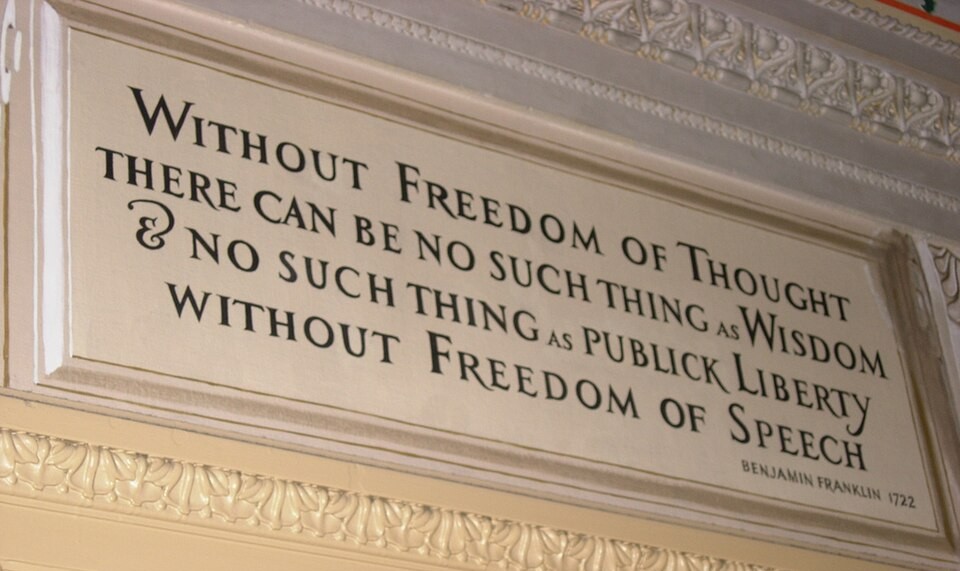
“We may learn our duty from the conduct of the oppressors of the world. They know that light is hostile to them, and therefore they labour to keep men in the dark. With this intention they have appointed licensers of the press.”
During the recent Reform-inspired clamour around various issues of Free Speech and censorship, my mind has on more than one occasion turned to the Welsh Philosopher Richard Price and his essay, A Discourse on the Love of Our Country. Published in 1789 at the outbreak of the French Revolution, as Europe railed against the authoritarian rule of Kings, it launched the Revolution Controversy provoking Conservative Edmund Burke to respond with his famous Reflections on the Revolution in France.
In his discussion of the grounds of patriotism, Price (a great friend of Benjamin Franklin, by the way) states that first among our “chief blessings” is the truth. He reflects that access to knowledge and ideas that constitute the truth are vital for any country, in order to avoid governments that are little more “than contrivances for enabling the few to oppress the many”.
Price’s writings, as so many from the Enlightenment period, remind us explicitly why freedom of speech emerged as one of the touchstones of modern democratic society. The world of the 17th and 18th century was one where censorship was the norm, where holding certain religious beliefs could risk one’s life, and where the ruling classes closed down dissent to maintain their authority.
Those like Price who sought progress and freedom understood that this would be impossible without the opportunity for people to learn about the possibilities of reform, constitutional government and connected ideals. Progress required freedom of speech and freedom of the press in order for ideas to circulate. “Ignorance is the parent of bigotry, intolerance, persecution and slavery” he said. “Inform and instruct mankind; and these evils will be excluded.”
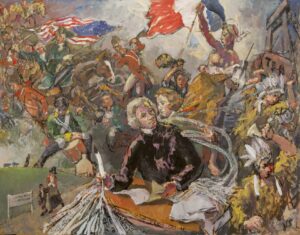
Given these historical origins, it may seem counter intuitive that it is political figures on the Right who have recently been waving the flag for free speech. By and large, of course, they have been railing against objections to their racism, intolerance and demonisation of immigrants. And according to many of those who have promoted the principle of free speech, they are perfectly right to insist on being given a hearing.
The most recognised 19th century advocate John Stuart Mill insisted that what we would now call ‘hate speech’ and other unpopular opinions should not be subject to the law, partly on the off chance that there may be some truth in them, but more importantly so that falsehood be exposed and the truth be challenged. He feared truth becoming a ‘dead dogma’ and so its vitality and meaning should be tested and renewed.
His ‘Harm Principle’ did however draw the line at speech that could cause immediate physical endangerment, such as inciting an angry mob to attack a corn dealer (or a hotel full of asylum seekers, for example).
Reform’s “Support” for Free Speech in Wales
The run up to the Senedd election has exposed some of the tensions in Reform and the hard right’s invoking of free speech. The most obvious case was the Students’ Union at Bangor University, where a debating society rejected a request from Reform to address them.
While Reform were quick to try and frame it as the University banning them from the campus, the fact of the matter was that they invited themselves and were subject to a caustic rejection, and did not appreciate a group of students freely expressing their views on the party. Not only did they subsequently attempt to frame it as a case of censure, they followed up with a threat to defund Bangor if elected.
This may have been a kneejerk reaction and a typically populist idea aimed at gaining traction with their base, but their instincts are instructive in this regard.
The erasure of the boundaries between institutions of civil society such as Universities and the state is typical of authoritarian overreach, and any ideological policing around issues such as who a debating society must host constitutes direct interference with respect to freedom of association and freedom of expression – a signal to other actors in civil society about the potential costs of challenging government (note Reform’s worrying proposals for dictating history to our museums).
Their apparent championing of free speech and their general tendency to undermine it is striking in other respects. Their attempt to pour cold water on questions around Dan Thomas’s residence in Bath led to him declaring he would only be engaging with friendly media over a cup of tea to clarify the situation. No proper clarification ensued, and in the main we have been left to reflect on how this mode of engagement with the free press has echoes across the Atlantic.
And only this week, their “top” candidate for Caerdydd Ffynnon Taf made a rather amusing if slightly concerning fuss about his MA project on the output of the nation.cymru news website. Despite the Daily Mail being the most read news outlet in the country, he is apparently so concerned about the impact of Nation’s focus on Plaid Cymru and ‘the entire Welsh media landscape’ being biased, that he’s apparently recommending state intervention through a review of Welsh media coverage. So much for freedom of the press.
Trumpist
Threatening Universities, discrediting certain media figures whilst cosying up to others, and decrying certain outlets is all very reminiscent of Trumpism, of course. And it is connected to a wider, darker and more unsettling attack on the truth making it far harder to discern, whilst presenting themselves as the anti-establishment purveyors of political reality, as it truly is.
Various global forces fuel conspiracy theories and scream fake news whilst simultaneously attacking those truths that built modern social and liberal democracy. And they have set about building a social tyranny through social media and their bots that Mill himself would have regarded as a potentially more powerful oppressor than any tyrant (and demonstrates the limits of his ideal of a market place of ideas where they are notionally given an equally reasonable hearing).
Of course in this respect we must acknowledge the equal tendency of the left in stigmatizing, excluding and censorship, building up a despotism of custom (so painfully exposed by Mark Fisher with respect to social media) – which ultimately undermines their own attempts to counter the hard right.
There are signs however, that the scales are beginning to fall from people’s eyes with regard to Trump and his British cronies, and there’s a growing realisation their politics is more generally riddled with the tensions present in their discourse on free speech.
His war on Iran has exposed them in all their stupidity, venality and swivel-eyed narcissistic and violent hypocrisy. Farage’s apparent immunity to critique is wearing thin: the promise of Brexit’s economic dividend is in tatters; likewise exposed are its consequences in terms of the immigration boom and a UK denuded of the ability to ‘send the boats back’; Farage has also now rowed back on his wild claims around re-opening mines and the blast furnaces in Port Talbot.
It must be said, and in light of the latest Senedd polling, that in some ways one can’t blame massive sections of the electorate for being led down the garden path, given that they have been so explicitly ignored, and that the political class has since Tony Blair spent a huge amount of time and effort manipulating their media relations and messaging (and just making stuff up like Iraq’s Weapons of Mass Destruction) – so much so that on one level we now take it as a given that it’s mostly an attempt at distorting reality and denying people’s intellect and everyday experience.
Plaid’s Prospects
Plaid, the main opposition to Reform in Wales, have the culture and the authenticity to avoid the worst of this (although can someone explain why Lindsay Whittle, hero of Caerphilly, is not on their every campaign video?). However, they are not immune.
To pick one prescient, local example to me, the Plaid-run council of Carmarthenshire is currently trying to close village schools in its heartlands under the banner of what they call ‘modernization’. Building new area schools, or seeking new ways of organising the provision of existing schools might plausibly be “modernizing” – closing schools at the earliest opportunity and shipping little children miles down the road is clearly not. And yet they persist with this sort of dissembling mealy-mouthed bunkum that we’ve all had a guts-full of and that has driven people into the arms of Reform. When language loses its meaning we should all be alarmed.
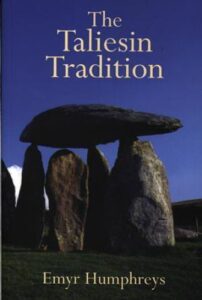
In addressing this situation, and indeed reflecting on the election run in, Plaid could do worse than look to a somewhat more ancient hero than Richard Price. As Reform continue in their attempt to sunder political truth from its moorings and create their own disorientating, paradoxical and hate-laced reality, it is arguably time for Plaid, its PR machine, and its poets, to channel the figure of Taliesin and engage in their own “myth-making” of a positive and liberatory kind.
We need a language that moves beyond the morbid discourse of managerialism. Memorably deployed by the novelist Emyr Humphreys in his literary history of Wales, Taliesin provided the archetype for Welsh survival with his shape-shifting abilities. The bard embodies the perpetual recreation of Welsh identity – in the face of English assimilation – through the strength and vigour of its verbal power.
If ever there was a time that Cymru needed to create a new truth from the furnace of poetic inspiration (to paraphrase Gwyneth Lewis’s Millennium Centre verse), to liberate itself from the fetters of contemporary discourse and redefine the language of politics, then this is it. As Price’s contemporary, and our greatest salutary myth-maker once said, “Y Gwir yn Erbyn y Byd” – The Truth Against the World.