
On our whistlestop tour of Wales to speak to some of the Senedd candidates, this time we head back north to meet Beca Brown.
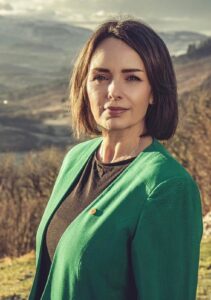
“Working as a producer was a formative period because it was necessary to build relationships with all sorts of people, and to build trust. I learned to give a voice to those who often felt forgotten.”
U: Where are you standing and what does that place mean to you, and how are the new constituencies presenting a challenge?
BB: I am a candidate in the expansive constituency of Gwynedd Maldwyn, something that makes me very proud, because many of its communities have provided me with invaluable opportunities and experiences. I grew up in Ardudwy before moving to Arfon, and as a child of parents who moved here from England, those places had a huge influence on our family’s journey towards Welshness and the Welsh language.
Yes, it is a large constituency. But one of the greatest pleasures of this campaign has been the opportunity to travel the length and breadth of the region, becoming reacquainted with some places, while getting to know others for the first time. I’m looking forward to the challenge – and the privilege – of being able to speak up for such special communities, if I’m lucky enough to get the chance.
U: How have you been involved in politics – party or otherwise – and any achievements you’re proud of?
BB: Politics and social justice have been of great interest to me since my mid-teens. I joined Cymdeithas yr Iaith when I was around 15 years old, where naturally I learned about the language movement, but also about the peace movement and about the challenges and struggles of people and cultures across the world.
When I was in my final year at university I took part in direct action with Cymdeithas as part of their campaign for Welsh language education. My friend Olwen and I spent two weeks locked up as a result, and being in a women’s prison at the age of 21 was a real eye-opener.
During that period I realised how incredibly challenging the lives of those at the foot of the social hierarchy can be – and how adverse childhood experiences can cast a lifelong shadow over women who have suffered trauma and abuse. I count those two weeks in Pucklechurch prison, Bristol, as a crucial formative period, in terms of my core values regarding how we as people should treat each other.
I naturally bypassed party politics while working as a journalist for the Western Mail and then for HTV Cymru, but I eventually joined Plaid Cymru, and was elected as a county councillor five years ago. Volunteering every week with the local food scheme has brought home to me the many challenges of the cost of living crisis, and it angers me that child poverty rates are so high here in Wales.
During the pandemic I adopted an ex-racing greyhound, and came to learn about the awful cruelty of the racing industry. That led to being part of the Greyhound Rescue Wales team which has successfully campaigned for the banning of greyhound racing here in Wales.
It sickens me to see the innocent and the vulnerable – regardless of who or what they are – being exploited for the benefit of others.
U: Where did you go to school? Any life lessons you feel are important for politics?
BB: I was a pupil at Ysgol Dyffryn Ardudwy and then at Ysgol Syr Huw Owen, Caernarfon. Campaigning was an important part of my time at secondary school, and I’m sure I was a bit of a nuisance! I played a leading role in a successful campaign to win the right for girls to wear trousers to school, and seeing or experiencing injustice tended to get me fired up. It’s possible that I wasn’t particularly good at picking my battles back then, but I’ve got better at that over the years! You have to prioritise in order to achieve…
U: What about your life outside of politics, any major experiences or jobs that have shaped you? Insights or expertise that serve you well?
BB: Working as a journalist and then as a documentary producer was a formative and significant period because it was necessary to build relationships with all sorts of people, and to build trust. I learned to listen, appreciate and act accordingly, and give a voice to those who often felt forgotten. Many of the programmes I produced were related to issues such as poverty, disability, health and social justice, and I tried to shine a light on the lives of those who are often invisible.
My time in cabinet with Cyngor Gwynedd was an acutely defining period for me, as I was responsible for the Education portfolio during a time of unprecedented turbulence. My service in cabinet ended earlier than intended when I stepped down alongside three colleagues on a matter of principle, relating to the case of the sex offender, Neil Foden. That horribly difficult time certainly taught me who I am.
U: What’s most important about politics in your opinion, and if you get in what will your priority be?
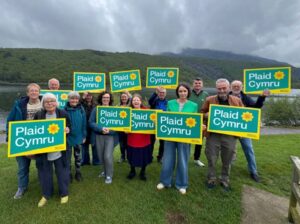
If I were lucky enough to be elected to the Senedd I would take with me all the stories, challenges and experiences that different people have shared with me over the years in my various roles. The women at Pucklechurch prison; the lads of ‘Sgubor Goch, Caernarfon; the families of Tŷ Gobaith, and everyone I have had the privilege of meeting through my work as a county councillor. My priority would be to create real, tangible change for those people – and for everyone who has waited far too long for something better.
U: As a Plaid candidate what is broadly your view on the question of Welsh independence, how it should be approached, how it relates to other priorities etc?
BB: Independence is a normal state of existence all over the world, but it takes self-confidence and self-belief to achieve it. Helping to build that hope and conviction is our job as politicians – together with anyone who is curious about what Wales could be.
U: And when you are not politicking where would we find you, and what might you be up to?
BB: Enjoying the many footpaths of Llanrug with the dog while listening to a podcast; or hanging out with my children, who are my favourite people in the whole world.