
We are thrilled to present another 3-part essay, this time from Planet Editor and visionary writer Emily Trahair. Here she looks forward to new horizons for the left (especially relevant to Undod) through looking back at her prophetic 2018 editorial.
I recently logged back in to Musk’s Twitter/X after a long time away. Navigating through my feed in hyperbolic mode, it felt like an eerie post-war battleground of Welsh political discourse, one where leftists had ended up on the losing side. It seemed near-deserted, overgrown with hideously mutated AI, most followers now exiled to other platforms or convalescing in digital detox. I had flash-backs to posts that had been key sites not only in the Left/Right culture wars but in utterly futile leftist in-fighting.
Now and again the odd fascist or misogynist carrion-eater would stalk my remaining followers’ threads, but many of these followers now seemed to be back in their civvies, posting innocuous/dull stuff about cats or career promotions, trying to be inconspicuous and not catch the baleful eye of the bots and trolls.
However, I took a detour, and stumbled into the first of several partisan strongholds – or maybe wormholes – where lefty hot-takes were being freely and productively exchanged like it was 2018 all over again.
It feels like this digital landscape has a parallel in the real world: on the surface it often seems like citizens have withdrawn from activism, and even from discussing politics with anyone who isn’t like-minded – burnt out by toxic fighting within activist movements, afraid of ruining an uneasy truce with family or old friends, needing to expend most energy into paying the bills.
On the other, there is an inspirational under-scape where mass door-to-door campaign work is beginning to be mobilised to fight the Far Right, and where innumerable conversations are happening with loved ones about why a left-wing alternative to Reform would best serve communal interests – efforts which proved stunningly effective in Caerphilly last year.
We are poised in a weird time weighted with both peril and promise: never before has the possibility of a Far Right government in the Senedd and at Westminster been closer. Likewise, surely not since the time of Glyndŵr has the Welsh independence movement been nearer to power, and never has the prospect of a substantially socialist government been as probable in devolved Wales (if Plaid and the Greens succeed in forming an administration with a radical programme). This is what many readers of this blog have been hoping for their whole adult lives.
And yet… in many pockets of Wales, engagement with left-wing, pro-independence politics seems the most listless it’s been in recent times, and in the face of a barrage of far-right disinformation, near-catatonic.
With the election date fast approaching, many of us are now wondering how to most effectively make up for lost time.
With this in mind, somehow I felt drawn to rethinking an editorial I wrote for Planet: the Welsh Internationalist magazine back in Autumn 2018. It concerns a set of subjects that remain relevant to the effort to defeat the Far Right in Wales, ones that have nonetheless elsewhere wreaked so much division (and misinterpretation) that many commentators now just tiptoe around them. around them. With this in mind, I have made the editorial freely available in order that all the nuances and caveats don’t need to be regurgitated in full.
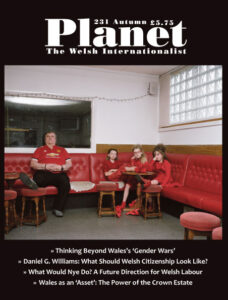
To distil down the main points: it described on the one hand the urgency to defend and further develop efforts to empower women and minorities in the face of a resurgent Far Right, and reiterated why these efforts are so important to begin with.
Using feminism as the core example, on the other hand it asked why the concept of politics on behalf of ‘the majority’ had often become perceived as anachronistic from a left-wing perspective, why this is so inherently troubling, and also likely to lead to defeat for the Left. The editorial gave voice to a growing, and at the time tentatively expressed, unease among my friends from many different backgrounds about how certain principles around diversity, representation, privilege etc. that we subscribed to in a general sense had often hardened into dogma, but unlike ideologies or creeds of yesteryear, without any coherent vision for how humanity could collectively redeem itself and improve life for everyone.
It outlined the various ethical, logical, philosophical and practical problems for left-wing movements (problems which have often since torn such movements apart) when concepts such as privilege-checking, ‘yielding the floor’, ‘calling out’ became diktats; and when notions of male fragility, man-splaining, micro-aggressions etc. often became cause for automatic ostracism rather than contestable expressions that are constructive in certain contexts.
The editorial attempted to demonstrate that it was often not a question of identity politics having ‘gone too far’, rather of having gone in the wrong direction, and indeed that there was still much further to go if substantive equality and justice for women and minorities was to be achieved. The piece sought to differentiate between the problems with contemporary identity politics that were inherent to this politics, and those issues that were rather symptoms of wider malaises, and which had become entangled with and tainted identity politics.
The first malaise could be summarised as ‘neoliberal austerity’. Neoliberalism destroyed the ability to think of ourselves collectively as a society, rather as individuals in competition with others. It also led to vast material inequality between the 99% and 1%, erosion of prospects for most, and poverty for many.
Simultaneously, an iteration of the diversity agenda became appropriated by the managers and HR departments of the (now neoliberal, if superficially progressive) organisations who rule our lives. This became problematic firstly as the same individuals who are impoverishing and disempowering us are also foisting a particular top-down narrative of EDI on everyone, thereby discrediting this agenda (and sometimes even deploying it as a divide-and-rule tactic against attempts to improve conditions for people collectively). Both the prospect of a progressive majority and support for minorities have been undermined by austerity, with state provision presented as a kind of zero-sum game where we need to scramble for the crumbs – in recent years it has been scape-goated refugees who have particularly suffered from this scenario.
The second malaise which identity politics has become embroiled with and near-synonymous with is, of course, the toxicity of oligarch-owned social media. As I put it in the editorial, ‘identity politics involves sensitive dialogue which goes to the very marrow of our selfhood. When this is mediated via de-humanising social media platforms designed specifically to enhance individual self-promotion in the “attention economy” (and thus raise profits through advertising algorithms) it can be disastrous for the kind of collaborative effort required to build unity in diversity.’
Unity in diversity – this was the crux of the 2018 editorial, and also, I’d argue, gets to the heart of transforming Senedd election debates.
In the next two instalments of this article, I’ll discuss the embryonic proposals I suggested in the editorial about a different kind of universalist politics which serves and can be supported by the majority while empowering women and minorities, and how such an alternative identity politics has been refined since 2018, and is now commonplace within leftist discourse. I’ll put forward why, however, there is still particular urgency to disseminate this vision further in the lead up to the election – and how.